Monday, 21 September 2015

Wildlife upside down 2: the top end

After Perth we went north, to Darwin, right at the top of Australia. We spent three days going into the bush in Kakadu and Arnhemland. This got us much closer to the "real" Australia, including seeing some insights into Aboriginal art and culture.

We were now in the land of beautiful sunsets and crystal clear skies. We were also staying in a lovely hotel right on a dock where there was a superb seafood restaurant. Not only did it serve giant mudcrabs, you could watch the sun go down with a beer in one hand whilst black kites, created terns, silver gulls and white-bellied sea eagles flew past and masked lapwings shouted the odds from the rocks.


In the parks, white-bellied cuckoo-shrikes, bar-shouldered doves and figbirds lurked in the trees,


whilst orange-footed scrubfowls, white and straw-necked ibis pottered about beneath them.


The next day we set off into Kakadu national park and Arnhemland. both of which took us well off the beaten path and into some very wild areas.
Our first stop was at Fogg Dam. This is a large wetland area that we found at later holds one of the largest biomasses of any creature, pythons, which are there in incredibly large numbers though we didn't see any.

Flying in this shot are two brolga's, large crane-like birds of he region.

There were large numbers of many typical wetland birds, including these purple swamphens. note their feet. It looks like sticks but they are pulling up water plants to eat.


With them were large numbers of whistling ducks, white-necked herons, comb-crested jacanas and green pygmy geese, themselves only the size of ducks!


It wasn't only waterbirds though, as there were lots of insects around attracting australian hobbies (another endemic), lemon belliedn and leaden flycatchers and feeding on seeds not insets, scarlet finches.


One thing i didn't expect to see, at least not in such numbers were pelicans. We ended up seeing them in a number of different places, but Kakadu provided large flocks of them.


In Australia of course, where you get water you get things which will eat you, and often those are giant crocodiles, especially salt-water crocs. We saw many, often of giant size, up to 16 feet long, and many more were presumably lurking out of sight.


In case you are wondering, that isn't a growth on one of the crocs, as we first thought, but a radio-tracking device, and no I don't know how the hell they got it on there!!

Second day we went deeper into Arnhemland and visited a number of sites which were sacred, if that is the right word, to the local Aboriginal tribes. The caves held some exquisite rock art.


In the woods around though were some cracking birds inlcuding sulphur-crested cockatoos, blue-winged kookaburras, 


We also went on another wetland cruise, seeing some new wildlife as well as some more crocs!

Green pygmy goose

Australian darter

Black-necked or jabiru stork

Pied cormorant

Rainbow bee-eater

Radjah shelduck

Azure kingfisher


White-bellied sea-eagle

 comb-crested jacana

and a rather self-satisfied pelican


Our last stop was another lodge closer to Darwin whre we spent 2 days doing not a lot, which was nice in itself. There were agile wallabies all around, mainly coming out at dusk to feed on the grass. this noe though was annoying to one of the local magpie-larks!


Some also had joeys in their pouches still...


Another highlight were these little corellas who were really enjoying the sprinkler which was keeping the grass green for the wallabies!


In the trees and using the termite mounds were many pairs of rainbow bee-eaters. I was surprised at how many of them their were, the number of pairs must have been in the dozens.


Other birds spotted included this Australian pratincole patrolling the airstrip outside our room,

blue-faced honeyeaters, which are quite large and were loving the blossom around,


and some smaller birds like rufous-throated honeyeater
 rufous whistler
 and forest kingfisher


Wildlife upside down 1: Perth

We took all of August off to do a tour of Australia. Although the holiday was not solely one looking at the wildlife we did still manage to see some spectacular sights and creatures.
Our itinerary took us from Perth to Darwin, Cairns, Uluru, Sydney, Adelaide and Kangaroo Island. So, our first stop was the bottom left corner, the coastal city of Perth
Virtually the first bird we saw, and one that was ever constant across the continent was the rainbow lorikeet. This smallish parrot was actually in a shopping centre and their colour and raucous calls added a very tropical feel to the town.

Surprisingly for an island there are very few gulls. Effectively, if you exclude rarities there is only one small gull, the silver gull. Like all gulls though they are just at home in parks as on the coast.

The park here was also home to another bird we met many times on our trip, the magpie-lark.

They are incredibly confiding and have a loud, strident call. In fact, black and white seemed to be the colour of birds in the park, as it also held, in order, willie wagtails, torresian crows and australian magpies.


On our second day we visited Kings Park, which is a very large area of formal and informal gardens almost within Perth - think Kew Gardens.
As well as most of the birds above there were a few other nice birds showing.
This is a white-cheeked honeyeater. This family comprises over 30 different species in Australia and if you are going there are the ones you need to practice identification on. Many are almost impossible to tell apart unless they call. This one was easier though!
A similar looking bird, although not closely related, is the red wattlebird. They are actually quite large, about the size of a green woodpecker.

Like many birds, this one also was tame, and i took this photo whilst having a cup of tea in the park!
Not far away we came across one of the totemic birds of Austrlia, the galah.
This pair were clearly thinking that Spring was in the air!
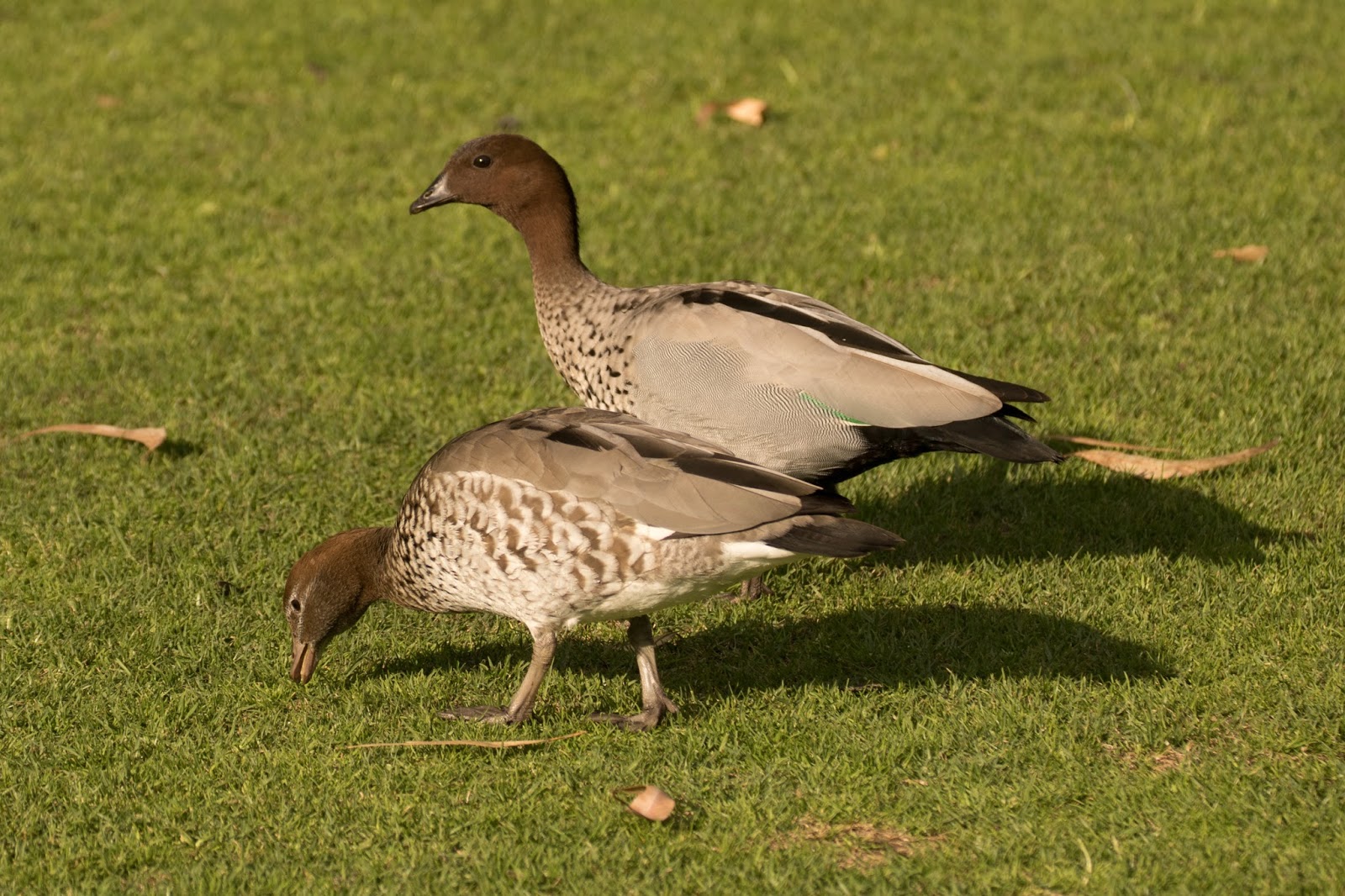
Being a park, there were a  number of waterfowl around as well, and two of the commoner ones were these wood ducks and this smart female Pacific black duck.


Other birds that we saw of note were pied cormorants, australian darters, brown honeyeater, white ibis, dusky moorhens, Welcome swallows and our old friend the house sparrow.

We also stopped at Perth at the end of our holiday, and spent the day on Rottnest Island. This is a 90 minute boat trip of the coast and is popular with locals and tourists alike for one main reason.
Quokkas!!

These small marsupaisl are the reason the island has its name when they were misidentified as rats, hence rats nest or Rottnest in Dutch.


 They are totally unafraid of people, in fact you get clusters of tourists around them with their own personal interaction going on.


The island itself is not large, about 5 or 6 miles long by a couple wide, and most people explore it by bike - there are no cars on the island apart from a few for the staff and rangers.
Wildlife apart from the quokkas was a bit hard to find as we were in Winter so most of the water birds which breed were not present, but there were some nice birds to be found. This is one of the birds clearly named after somethnig the early settlers found similar, the red-capped robin.

This smart looking chap is a white-fronted chat.

On the water were these black-winged stilts, as well as Australian shelducks and Caspian terns.

 On the land were more galahs and this cheeky pair of Australian ravens.


In summary, despite us not really doing the area justice Perth was a great start to our holiday and definitely a place to recommend visiting, especially the quokkas!!

Friday, 18 September 2015

A right buff bird

I've just got back from taking August off in Oz, so the UK birding has been a bit slim. Autumn however is upon us, bringing with it the promise of rare birds turning uo anywhere and anytime. So, with the option of taking a Friday off I perused birdguides to find any juicy morsels.
First up was Dorset, with a buff-breasted sandpiper at Osmington Mills. This would be a lifer for me, and is in an area I know well.
A 5.15 start got me to Dorset by about 8. I had a small issue with finding the car park, but eventually I turned up in a nice sheep field overlooking Portland.


It took about 15 minutes to find the right field, along a track parallel to the coast. The sandpiper was apparently cosying up with a small flock of ringed plovers. I thought that was strange to start with, as you normally think of plovers as being on marshes and estuaries not a dry field on top of a cliff.
Who am I to say anything though. There was a small flock of about 10 plovers happily pottering about in the field.

Fortunately, alongside them was another bird - the buff-breasted sandpiper.

I spent about an hour in all watching it happliy feeding in the field. Another birder turned up as well, Mark, who was more local than me and was very excited to find the bird as it was a lifer for him.


A really nice bird and a good start to the Autumn.

this still left me the rest of the day though, so I headed off down the coast to West Sussex. Basically it was where I went for the Hudsonian Whimbrel in spring. this time though the main target was a grey phalarope. Normally these are either on the sea and distant or skulking at the back of a marsh. This one however was almost too close.

We stood by a pool next to a road, with cars hurtling past behind us, whilst the phalarope kept going back and forth happily feeding in the shallows. It was ridiculously close at times.


The second course on the pool was a rather elusive and skulking pectoral sandpiper, with an overflying merlin hunting hirundines adding a bit of excitement as well.
Finally I moved down to Church Norton. In the actual churchyard were a pair of flycatchers - a pied and a spotted.

The spotted was showing well but was also very territorial and everytime the female pied flycatcher settled it was moved on, so no photos!!
Still, a good start to the Autumn campaign.