This is the 4th of 4 posts regarding our trip to the Okavango Delta and will focus on the bird life.
In theory this is the quietest time for birding. Dedicated bird trips would go in our Winter, their Summer, when the number of migrants is much higher. Even so, we got 217 on the whole trip, and 153 in the Delta without really pushing it on the lbj front!
I'll try and deal with them in a semi-logical way. The first thing which I was slightly surprised about was the raptors. I was expecting there to be large numbers but we only got 11 different species comprising 3 different vultures, 5 eagles, Dickinsons kestrel, black-shouldered kite and african marsh harrier.
 |
| These are white-backed vultures, the commonest of the 3 we saw. These ones just reminded us of the ones in the Jungle Book, pretending to be the Beatles. They are actually waiting around near a lion kill. |
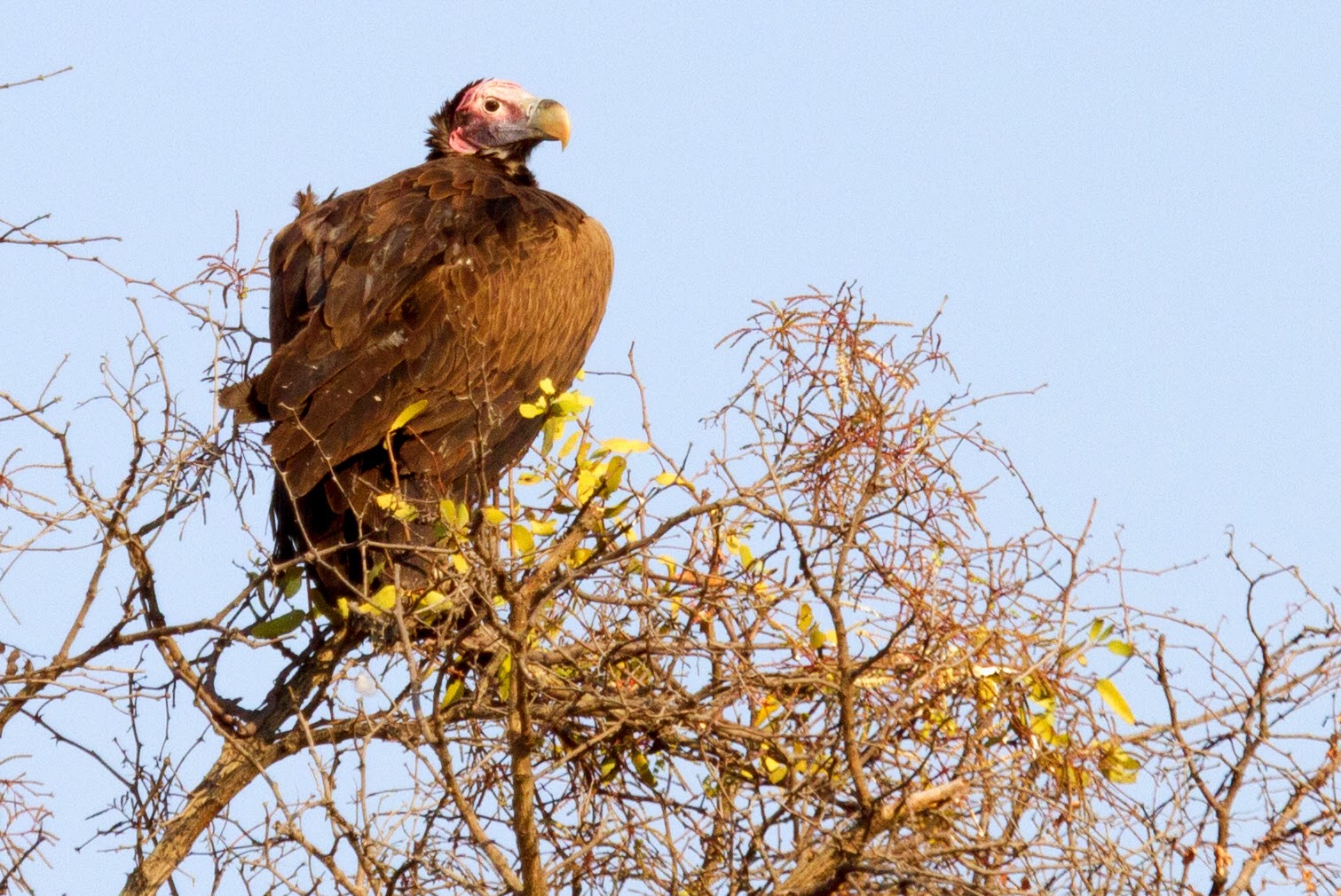 |
| By contrast this is a hooded vulture, also waiting around at the same lion kill. The last one, which I don't have a good photo of is the lapped-faced vulture. |
Our closest encounter with vultures though was on the flight from Shinde to Lagoon. We were only at a few hundred feet over the delta when the pilot banked sharply to the left. This was unusual as they pretty much fly straight lines. Suddenly past the right-hand window I saw a stack of dozens of vultures, obviously using a thermal to climb. The pilot had, luckily, seen them and banked out of their way. After we were past he turned right and came onto the best course. In a small Cessna you don't want to run into a vulture!!
The other large raptors in evidence were the eagles. Mostly they were fairly fleeting glimpses and to be honest I relied very much on the guides to i.d. them. The issue is that compared to here, there are so many potentials and they look pretty similar when soaring.
One we did see close-up and on more than one occasion was tawny eagle. This is a rare bird in europe but is common-ish across sub-Saharan Africa.
This highlights the challenge of raptor identification. It's a large bird, probably an eagle, but at distance scale and colour are hard to determine.
Get closer though and you can see the detail. There is a clear honey-coloured head, very large beak and the bright, piercing eye of the true eagle.
Get it in the air and the light-brown underwing with darker trailing edge and squared-off tail become visible. What you have is a majestic bird of prey.
The commonest of the eagles though, and one which in Nxabega and Shinde we were seeing many of each day, was the bataleur. In adult plumage this is a handsome crested bird. The one here though was a particularly confiding juvenile bird. It just sat in its tree as we got closer and closer, peering down at us. We sat for almost 10 minutes hoping to get a shot of it flying it. We tried stsarting the engine, moving away and back but it just sat there, so we left it in peace to enjoy the late afternoon sun.
Over and around water though, and with a cry which echoed across the marshes were the African fish eagles. Similar to the American bald eagle in some ways, pairs occupied territories around the larger bodies of water, catching fish off the surface. Often though you saw them declaring "this is mine, keep off" from the top of the tallest tree.
As night fell of course, the eagles and vultures get replaced by the owls. The guides sometimes have an almost sixth sense about finding them at night, and we came across this Scop's owl in a bush.
This rather poor photo is a marsh owl which was on a path only just outside the camp at Shinde.
Of course, during the day the owls don't disappear, they just lie up in trees and if you are lucky you can find them awaiting nightfall. This is a Scop's owl, the same type as we saw at night, but this time in a tree about 20 feet outside our dining room. It sat there all day.
This one is a pearl-spotted owlet which Aubrey not only saw but managed to call down out of its tree. I suspect this is one of his "banker" birds which he knows is always in that tree and can use when things get quiet, but hey, it was sweet.
Finally, and totally surprisingly, is an owl with very fetching eyelids. I've seen eagle owls before, and this is a Verreaux's eagle owl, but I didn't know about the pink eye-lids. We actually saw three separate birds, two roosting in trees and one in flight. At Lagoon, we were alerted to it's presence by smaller birds mobbing it repeatedly and without much effect as it stayed all day!
Finally on the theme of carnivorous birds are the kingfishers. Three different ones stood out. First, the malachite. This is a tiny bird, smaller by far than our common kingfisher but relatively common in the wet areas of the delta. It perches on reeds waiting to find what must be tiny fish in the pools below.
Very common around the camps were these striped kingfishers. They are one of members of the family that are just as happy picking up food from dry land as from the water. This family saw around the camp at Nxabega and were always very obvious distinctive cries.
Normally found around water though are the pied kingfishers. In Lagoon our "tent" fronted sstraight onto the river with a handily placed stick. One afternoon I was just pottering outside when thisd one came in and sat on the twig. I immediately saw it had a fish in its beak that it was trying to realign so it could eat it. I banged off a few shots before it flew off.
It was only when I looked at the photos on the computer that I realised it wasn't just realigning the fish, it had literally speared it on its upper mandible.
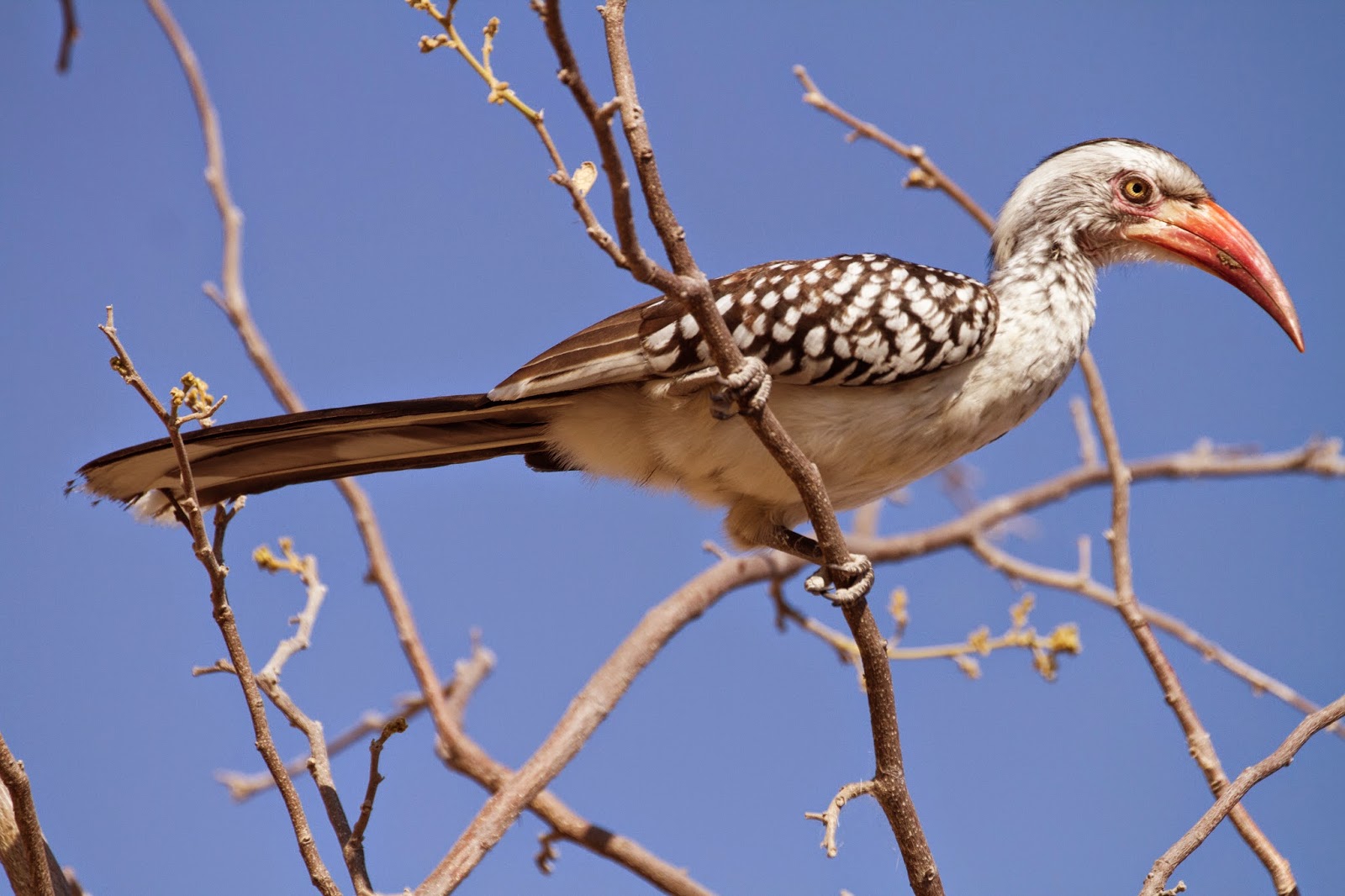
Another family we saw a lot of was the hornbills. In Botswana you can see 5 types, red-billed aka flying chili pepper, yellow-billed aka flying banana, grey hornbill, ground hornbill and Bradfields hornbill. We saw the first 4 commonly and got the last in Victoria Falls.
The ground hornbills are the size of turkeys are strut around the bush in loose family flocks of 8 or 10 birds. They are looking for insects, frogs and occasionally snakes to eat.
When they do find a particularly tasty morsel they hve a lovely habit of tossing it up in the air and catching it, like a child does with a smartie as a party trick.
Their smaller cousins are widespread and all 3 occur in all habitats. We often found large numbers feeding round the airstrips. This is the flying chili pepper,
this one is the african grey hornbill,
and these are the flying bananas, probably the commonest of the 3.
So, can you tell which is which??
Even though we weren't in the best season for them, some of the colourful residents are the bee-eaters. We saw 4 different types with the commonest being the smallest, the little bee eater.
These are only the size of martins and pairs hunt the open bush from low bushes and trees.
By contrast the swallow-tailed bee-eater is larger and much less common. We only saw them in Shinde but they are easy to tell apart, with their longer tail.
This handsome specimen is a white-fronted bee-eater and was from Lagoon camp where we actualy saw it whilst on our river cruise.
Almost the first bird we saw when we got to Nxabega was the lilac-breasted roller, or lbr as it is known. I was excited, the guide less so. I soon realised why. They are ubiquitous and widespread. You would see dozens, literally, every day. That shouldn't detract from them though, for me they are the spirit of the place - beautiful, charismatic, exotic.
As well as the lbr, you also get their larger and rarer cousins the purple roller.
For the rest of the birds, I will just show a selection of some of the better shots or better birds. I'll split them into water-based and land-based as a sort-of logical classification.
with so much water, there are clearly a lot of birds relying on it for food and shelter. This is a small cormorant., the reed cormorant
Much larger, but filling the same niche of hunting fish underwater is the African darter or snakebird. They are so-called because of the serpent-like shape of their neck, although it is not as sinuous as the anhinga of south America.
There are lots of herons and storks. This is a yellow-billed stork, a large bird often wading the edges of the lagoons or seen flying across the marshes.
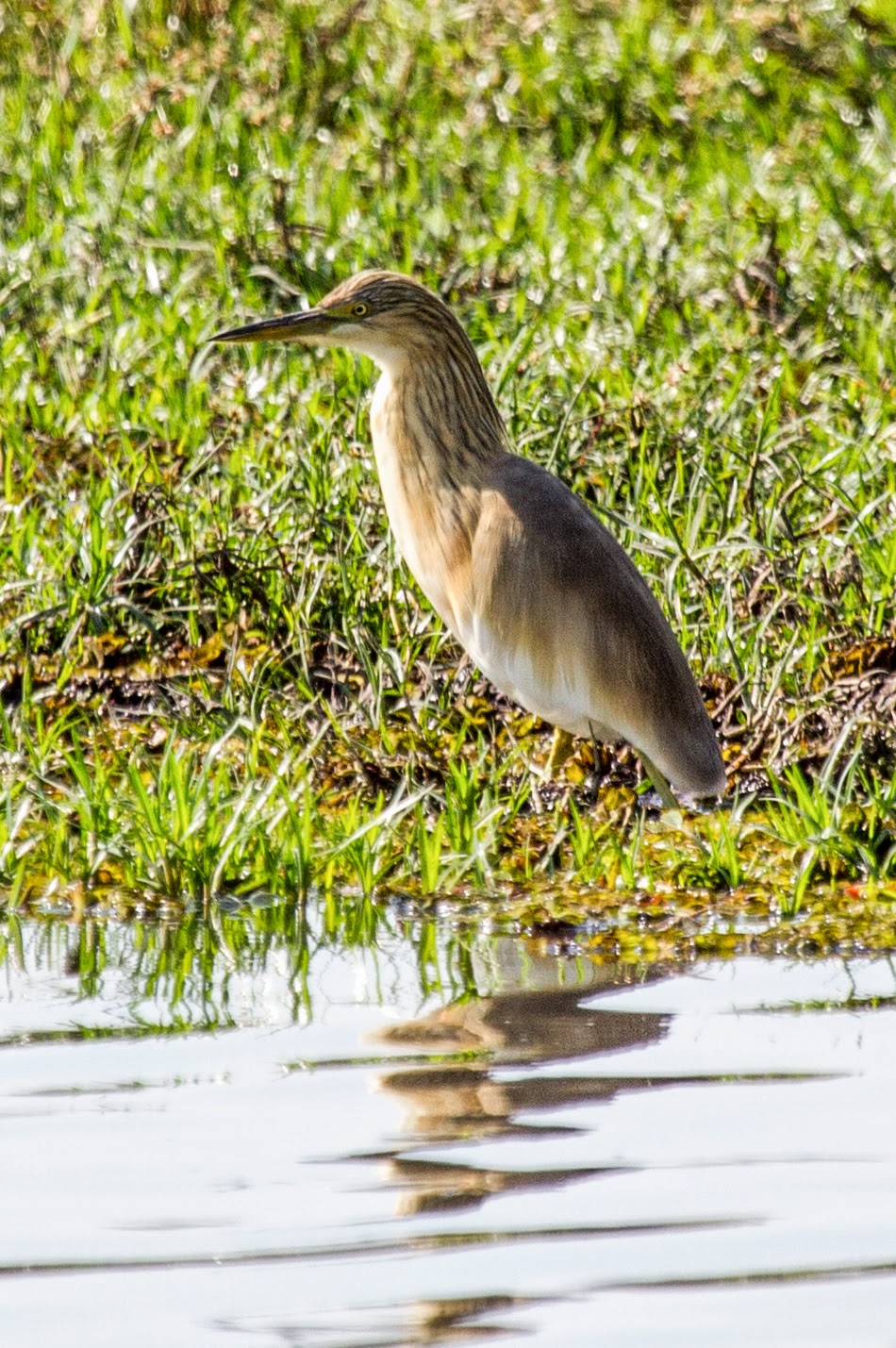
A much smaller bird is this squacco-heron. This is more of a lurker near reeds, like its many allies such as black, rufous-bellied and green heron.
One almost unique bird, and one impossible not to notice is the hammerkop. It is named because of its extraordinary-shaped crest on its head. It is a relative of the herons and every small pool seemed to have one catching frogs and small fish as the waters receded.
Most ecological niches have a similar solution, so where we have coots and moorhens, the delta has jacanas. I have already mentioned these, the top in the commoner african jacana, whilst the lower is the much rarer lesser jacana.
Of the birds on land, many were seen around the camps. This is a created barbet, a large finch-sized bird with a very strong bill.
Another bird heard before being seen is the grey lourie or "go away bird" because of its distinctive call, supposedly saying "go awaaaaay go awaaaaay". They are magpie-sized and very common in the camps.
A very beautiful bird, but one which was quite shy, was this, the African green pigeon. They tended to either be seen flying over the bush or sitting high up in the trees eating jackal berries, where any were left after the elephants had been through.
On the ground there were a a variety of robins, chats and thrushes. This smart boy is a kurrichane thrush.
The camps were generally in small glades or woodland areas so had a number of birds associated with that habitat. We had 4 different woodpecker species, but this was one of the commonest, the golden-tailed woodpecker.
A very exotic bird, and one which I had hoped to see was the green wood-hoopoe. I imagined they would be rare but in fact they are a common if shy species. They feed on trees, prising bugs and larvae out from the bark with their long bill.
Finally, there is the African relation of a bird high on most twitchers want-lists in thr UK, the hoopoe.
Outside the camp are a whole set of different birds, adapted to living on open-plains. Many are small and not easy to photograph from moving vehicles, such as queleas and fire-birds but others give themselves up a bit easier.
Many are adapted to eat the numerous insects, such as this black-crowned tchagra.
Others are lurkers in the long-grass such as this black-bellied bustard, quite a small member of the family.
Taking the role of our magpies on the open plains. this is actually one of the rarer species, a senegal coucal, told by its larger size and more chestnut colouration.
I was surprised that we didn't see more nightjars, but it is winter and cold at night so few insects are flying. We did find this fiery-necked nightjar on a path one night though.
There were lots of lbj's around, and we missed identifying quite a few. Those that did show could be identified eventually, though again I often relied on our guides. This is an african pipit.
Lastly, there were a number of "game birds". This double-banded sandgrouse was reasonably confiding, but there were also numerous francolins.
As a birding destination the delta is superb, and this was the low season. You really need to do your homework before you go and get a good guide, but if you do you can see some superb birds, close-up and with wonderful photographic opportunities.