Sunday, 14 February 2016

A weekend at the Lodge

Rather than disappear off for the birds I let them come to me this weekend. Nothing that exotic but  both Saturday and Sunday morning down Maple Lodge did yield one or two nice birds.
Saturday morning was the work party but I had about an hour wandering around first. It was pretty bleak and cold and definitely not spring like. Sunday was with Judith and the weather was a bit brighter but still pretty cold.
There were good numbers of redwings in the plantation area feeding up before they start their journey back up North.

The reed bed on Sunday was looking nice in the weak sunshine but it will be a few weeks yet till it resounds to the songs of the reed and sedge warblers.

The only birds showing any signs of active it was this wren from Rotunda hide enjoying the sun on Sunday.


There isn't much sign of colour yet, a few primroses around but the only flowers were a few trees with blossom and some clumps of snowdrops, these ones being in the band owl meadow.


The main action on both days though was from the Clubhouse his, with lots of visit to the bird feeders, even from coots and moorhens.


The feeders themselves had a steady stream of birds. Nothing rare or unusual but nice to see all the same.
The light on Sunday was much better especially for this female chaffinch.

 The great spotted woodpeckers always give a lovely splash of colour when they come in to the nuts. 

They're even nicer when you can get them against a more natural background though.


One of my favourite though are the long-tailed tits. They always seem to have "attitude" and their calls when they come along in their flocks are joyful!


Elsewhere the goldcrests were busy in the conifers, there were at least two pairs of treecreepers showing well, over 30 wigeon were on Lynsters lake and both little and great-crested grebes were showing amorous signs opposite Long Hedge hide.

Friday, 12 February 2016

Fudge-tastic

There were a couple of birds local to me which were just crying out to be twitched, so who was I to turn them down.
The first was the over-wintering hawfinches at Bramfield. Normally two but up to 5 have been present for some weeks now. These are exotic finches, looking like a chaffinch on steroids. They are much larger and have beak more reminiscent of parrots! They are uncommon but can be regular in their over wintering haunts. Normally I've gone down to Lakeside near Southampton to get them but these were much closer.
Bramfield is a small Hertfordshire village with a lovely old churchyard. The pollarded trees made it look a bit sparse on a cold morning!


After only a few minutes I spotted a large finch on the top of one of the trees at the back of the churchyard.


You can just about make out the large bill on this smart male. Over the next half hour the two birds flew between the churchyard and the nearby rectory but never really stayed out in the open!


With the morning moving on I left Bramfield and headed off towards Milton Keynes for another bird I get most years but is not exactly common. This one was a ferruginous duck. It is well named in that the males are definitely rust coloured! Again they can be quite loyal to areas including one near Blashford which gives ridiculously awful views through a chain-link fence! This bird though was reported as being on an a lake by a housing estate so should have been easier. On getting there I quickly found a female red-crested pochard lurking near where I parked the car.


Of the ferruginous duck though there was no sign. One local had been there for 3 hours already so it was definitely not around. Two days before though it had done this and had hopped about half a mile away to another lake. So, I too hopped into my car and drove about a mile and half to a pub car park by a lake. 
Almost immediately I spotted a group of about half a dozen tufted ducks and with them was another duck with a white bum and a very bright eye.

Along with the eye and the bum there was that beautiful rich rust colour as well.


I watched it for about 30 minutes as it drifted around looking quite happy and contented.What was so nice was that I was the only birder and the views were by far the best I've ever had for this species.


 With lunchtime approaching and the fudge duck going to sleep I left to move on to Amwell to see if I could find any gulls.
By the time I got there it was getting quite cold and windy. The reserve was looking empty of both birds and birders. I did manage to find the female smew lurking at the back on one of the islands.

I was mainly though trying to find yellow-legged gulls in the roost. There were lots of common and black-headed gulls as well as some larger ones, mainly lesser black-backed, herring and a couple of greater black-backed. I finally though managed to get onto one bird with a mantle between herring and lesser black-backed and a very clear bright white head. This pointed to a yellow-legged but I'm not confident enough to i'd it just from that.
It though start vigorously preening in the water and I clinched it with a shot of yellow on its legs as it came out of the water.

Honestly, you can make it out!!


You can make out the intergrade mantle colour and see its clear white head on the other photos.
Other than that there was a very brief view of the long-staying bearded tit before I gave up and headed back home.
Three nice birds with the fudge duck being probably the star of the year so far!

Friday, 29 January 2016

Sideways in Norfolk

One of my bogey birds at the moment is Pallid Harrier. I've dipped on them three times so far, once by about 10 minutes after it showed as I was driving out of the car park! So, a long stayer in Norfolk was a temptation not to be missed. The only down side was that the big storm which had dumped feet of snow in the USA was heading our way with high winds predicted!
Never mind, I got to Norfolk early doors hoping the forecast might be wrong. It wasn't. The harrier had been seen at Abbey Farm near Flitcham, just north of Kings Lynn. On opening the door you could tell it as a tad breezy. Fortunately though two other birders were just coming back to the car park and confirmed the Pallid harrier was braving the elements and was hunting over the fields.
It was only a very short walk to a few hay bales which seems to be acting as an impromptu shelter for  birders. 
First up I saw there was game strip with feeders on it that was attracting a number of small birds. I thought first of all it was chaffinches but then you started to se there were a number of bramblings, then that it was mostly bramblings!!    


Not only were there brambling, but a healthy colony of tree sparrows was mixed up with them. I guess there were at least 40 possibly 50 bramblings, by far the biggest ever flock I have seen.
The main course though was the harrier or should I say harriers. The first bird to pop up over the stubble field wasn't a palled harrier but its cousin a hen harrier. These are now very rare in the UK with the population down to a very few or perhaps no breeding pairs in England. The blame is put at the door of the shooting industry and the managed game estates. Quit soon another harrier was in the air, and this was my target bird - the pallid harrier.

Yes it is in this picture! It was favouring a hedge line at the back of the field probably as it may have given it a bit of protection from the wind. Going into the wind it hardly made any progress, with it behind it, the field was crossed in seconds!
I watched it for about 30 minutes and gradually it came a bit closer letting you see it's very striking markings.


It had a very noticeable almost golden tinge to its plumage, a slight ringtail when it turned and that amazing head pattern. It often stooped down into the field causing panic amongst the small birds feeding on the grain.

With the wind if anything getting worse I bade it goodbye and trundled off on my usual route along the coast.
No more photos as everything was hunkered down but I did manage to pick up a number of new birds for my year list. Ringed plover, snipe and mergansers at Titchwell were nice if not exactly rare! Better were the white-fronted geese and english or grey partridge in the fields near Holkham. Finally a guillemot was sitting on the sea at Cley. I had hoped to find both snow buntings and shorelarks on the beaches but the sand was coming sideways and taking your skin off so no self-respecting bird was going to hang around much!!!
I gave up about 3.30 and wended my was home. First lifer of the year, up to 120 for the year so far and a nice brill acquired from our favourite fish shack for tea!! What not to like.
    

Saturday, 16 January 2016

Que serin serin

With Winter now starting to get set in there are fewer and fewer "good" birds to go for. You can always amuse yourself with getting year ticks of common birds or you can go for some of the longer staying birds which make for much better ticks. Two of these were the party of serins which have taken up partial residence at Fen Drayton lakes in Cambridgeshire. These are birds of normally warmer climes than here and like many go into that group of previously much more common. They don't breed her but are regular visitors, never in large numbers but now a truly twitchable bird, or in this case birds, are worth getting out of bed early for.
So, another early start got me to a very frosty and cold Fen Drayton just after dawn. This is a relatively new RSPB reserve, a series of lakes and roadbeds on the edge of the fens. I'd been there before for Baikal teal and black-winged stilt. It's a bit of a strange reserve being bisected by a bus
tramway taking commuters to and from Cambridge!
Anyway, after a warming and reviving coffee I set off out the car park. The birds were only a short walk away, normally feeding on the verges of the bus tramway in the company of goldfinches and redpolls. After an hour though there was nothing moving! A couple of marsh harriers drifted over the sedge beds, a family party of bullfinches kept myself and about 10 other birders amused but if the sins not a tweet. Then finally there was a sharp trill and a small bird flipped up onto a nearby tree. It only stayed for about 30 seconds but enough for the gathered hordes to agree on female serin. Fortunately as it flew off we tracked it and all followed it down the tramway to the bus shelter (it sounds urban but it's really not!!).
We had another 20 minutes or so wait until someone called out "low down, far side" and there were both birds happily feeding away.


They didn't seem to upset so we all gradually got a bit closer as they continued to pull seeds from the plants by the verge.


Every so often they would get either bored or spooked and move on, sometimes a few feet, sometimes getting lost for 20 minutes or more.


After about an hour watching I called it a day and headed home.


Wednesday, 13 January 2016

Duckin' and diving

I had my annual trip to see my accountant today to get the year end tax return sorted! After only being told off slightly I decided to make a day of it and do a bit of birding.
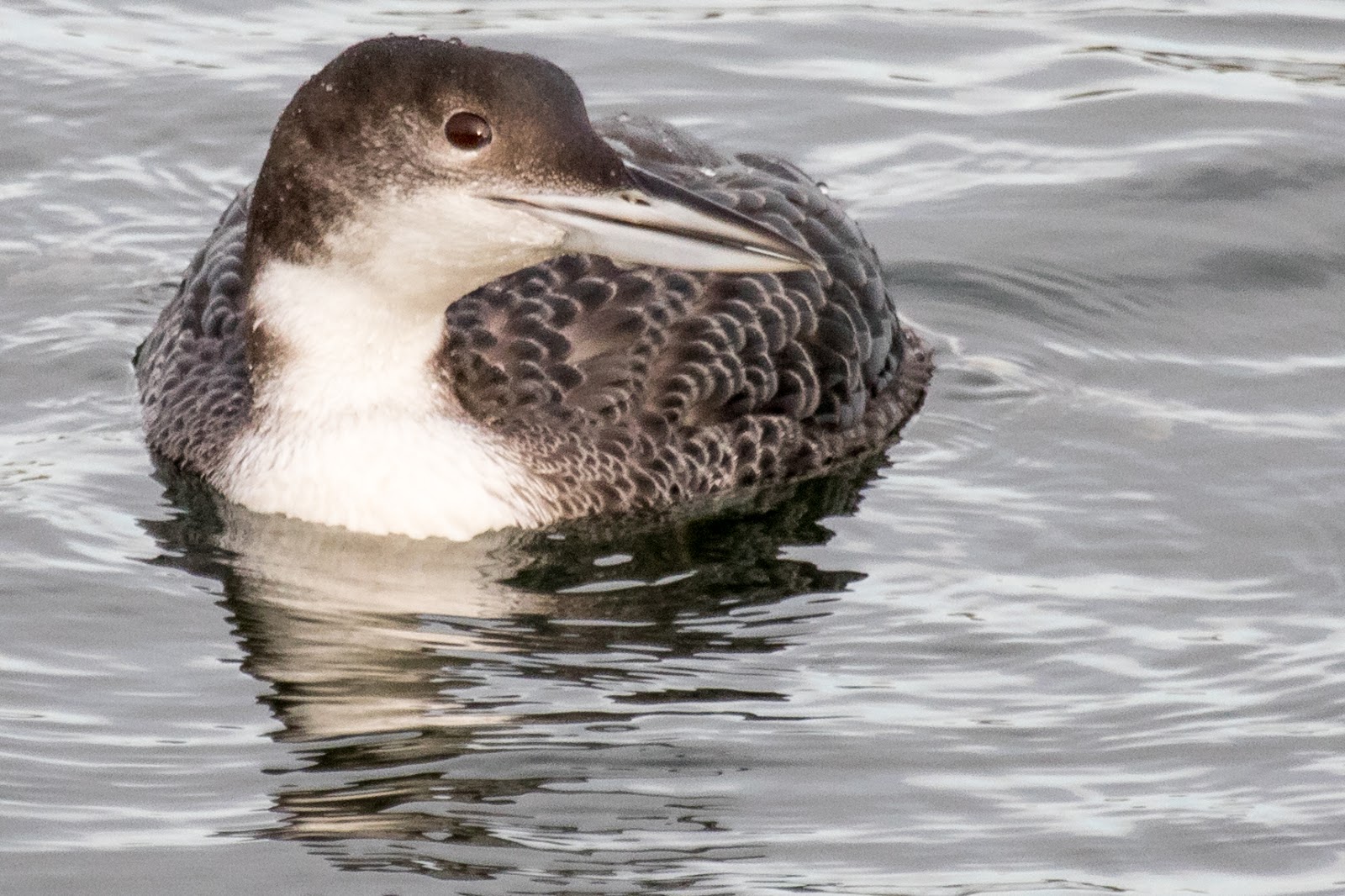
First off was Farmoor, a pair of gravel pits the far side of Oxford. I'd been there last for a rather nice red-necked grebe and it was a distant cousin this time which was attracting me - a pair of great northern divers. Normally associated with either Scottish lochs or the coast there are normally a few of these large divers over-wintering inland making use of the well-stocked fishing lakes and pits.
The weather was chilly, unusual for this year, but at least it was not too windy when I got there. Sometimes you have to work hard for birds, sometimes not. Fortunately this was a "not" time. One was immediately obvious about 50 yards off the sailing club.

This one proved to be a bit shy though and after a few minutes of preening and fishing it swam off and around the corner!

Great northerns are one of the 3 common divers we get in the UK, along with red- and black-throated. These two are very uncommon on inland waters in southern England. They are also smaller and altogether more delicate compared to the larger, bulkier gnd's. These are in their dull winter plumage as opposed to the much smarter breeding plumage which they will get in a couple of months as Spring comes on.
On the other pit, only separated by a narrow walkway, it's friend was much more obliging though. This bird was fishing only about 20 yards off the bank!


Well, when I say fishing I watched it for, I guess, 30 minutes and despite it diving very frequently I didn't see it catch anything!! It was VERY loyal though to the same patch enabling me get quite close to it.


Sometimes it got a bit bored of not catching fish and had a bit of a preen which involved rolling over and scratching itself with its long webbed foot.


I was tempted to hang around and see if it ever caught lunch but I had other stops planned which involved a bit of motoring so I left it and struck off across country.
Next stop was Henley Road gravel pits in Reading, a new stop for me. It is on the edge of the town and not easy to find, especially after the sat nav dumped me in a housing estate!! Finally I got to the site, which is another set of pits, this time with a Steve Redgrave and Matthew Pinsent rowing club attached. I was looking for a more natural setting though and there were three pits which looked good. My target was a smew but no clues as to which pit it was on, and no there birders around.
Sometimes, as I said though, lady luck smiles on you and the very first pit I looked at turned up trumps.
Smew are another of our winter ducks, previously more common and almost annual in Rickmansworth. Now they are harder to find but are well worth seeking out, especially the very smart males. The downside though is that they do tend to be a skulker and this one was no different. It was tucked up on the edge of the lake fishing but underneath the overhanging branches.


These two give you a slightly better idea of what it is like - a very smart white bird with black highlights. There was a female around somewhere though I couldn't find it. They look very different, plainer with a redhead.

After here I had one final stop before going home. Staines reservoir is another large body of water and is recognisable to anyone flying out of Heathrow at it's right at the end of the runway! It is massive though, with two separate basins each holding hundreds of water birds, but nearly always miles away. Today was no different. With two other birders who arrived just after me we did manage to find not only my two targets - scaup and black-necked grebe - but also another 2 great northern divers! The scaup is a diving duck superficially similar to a tufted duck but a bit larger and males have a grey rather than black back. This one took some finding as there were at a guess 500 tufties, probably more, needing sifting through. It didn't help that it was asleep as well. The grebe was slightly easier to find as there was only a couple of little grebes hanging about to confuse. Otherwise there were a a few goldeneye about as well as the usual common ducks.
So, a good day, both useful and productive, 4 more for the year list which is now up to 103. Will try to get to 120 by end of the month but that may be tricky!