Wednesday, 17 May 2023

Hare-ing about

 With some good weather promised and a day free I decided to have trip out. I'm not really chasing year-lists this year but it's nice to see what you can find. My main focus was on Lincolnshire and the reserve at Frampton Marsh. I got up early and by just after 7 was heading into the flat countryside. The farmers were already up and I passed a minibus discharging workers into the fields! On the other side of the road to them I spotted some distinctive humps in the fields. One sat up and the group ambled away as the farm workers came down the road!


I decided it might be a good day for hare spotting so I carried on to another field where the grass was short and I struck lucky: another group of about half a dozen hares. For 15 minutes I used the car as a mobile hide. One came particularly close as it bounced across the fleece-covered field giving it a rather wintry feel.

It joined its friends and they variously snoozed, groomed and chased each other around.


Eventually they all moved off into cover and I drove back the way I came to go to the reserve itself. As soon as I got out the car there was bird-song everywhere. It felt very Spring-like. Frampton is a marvellous reserve with loads to see, even from their car-park where a smart shoveler and avocet were pottering around.

After a coffee and a roll I headed off to the accompaniment of warblers, mainly sedge, singing either side of the path. 

They were joined by reed warblers and buntings, all giving a soundtrack to the morning.

The marsh itself was fairly quiet, though there had obviously been a hatching of avocets as many of them had chicks pottering around in the shallow margins. Even when newborn they have the characteristic upturned-bill, albeit in a smaller form! Being very precocial they were already feeding for themselves on small insects.


There weren't many other waders around unfortunately. The nesting little-ringed plovers were pretty distant but redshank, lapwing and oystercatchers did come near enough for a photo opportunity.


I only found one spoonbill, normally a commoner bird here, and as usual it was mostly asleep! 
The big downside was the number of dead gulls I saw.. There is a large black-headed gull colony here but avian flu is clearly present. Without doing a full count I would estimate I saw 80 or so dead birds, although many more were seemingly healthy. 
There was one more star bird but I'll update about that at a later point!
With there sun getting quite hot I headed home, stopping on the way back at Shardeloes. This is near Paxton Pits and is a stronghold for nightingales. With it being 1pm I wasn't hopeful but within a minute of getting to the right area I heard four or five birds singing away in the dense cover. Views were subliminal at best but it was lovely to hear them! 
I know I said I wasn't year-listing, but that did take me to 184 for the year. Normally I'd be well over 200 by now!!


Friday, 28 April 2023

It only took 15 years

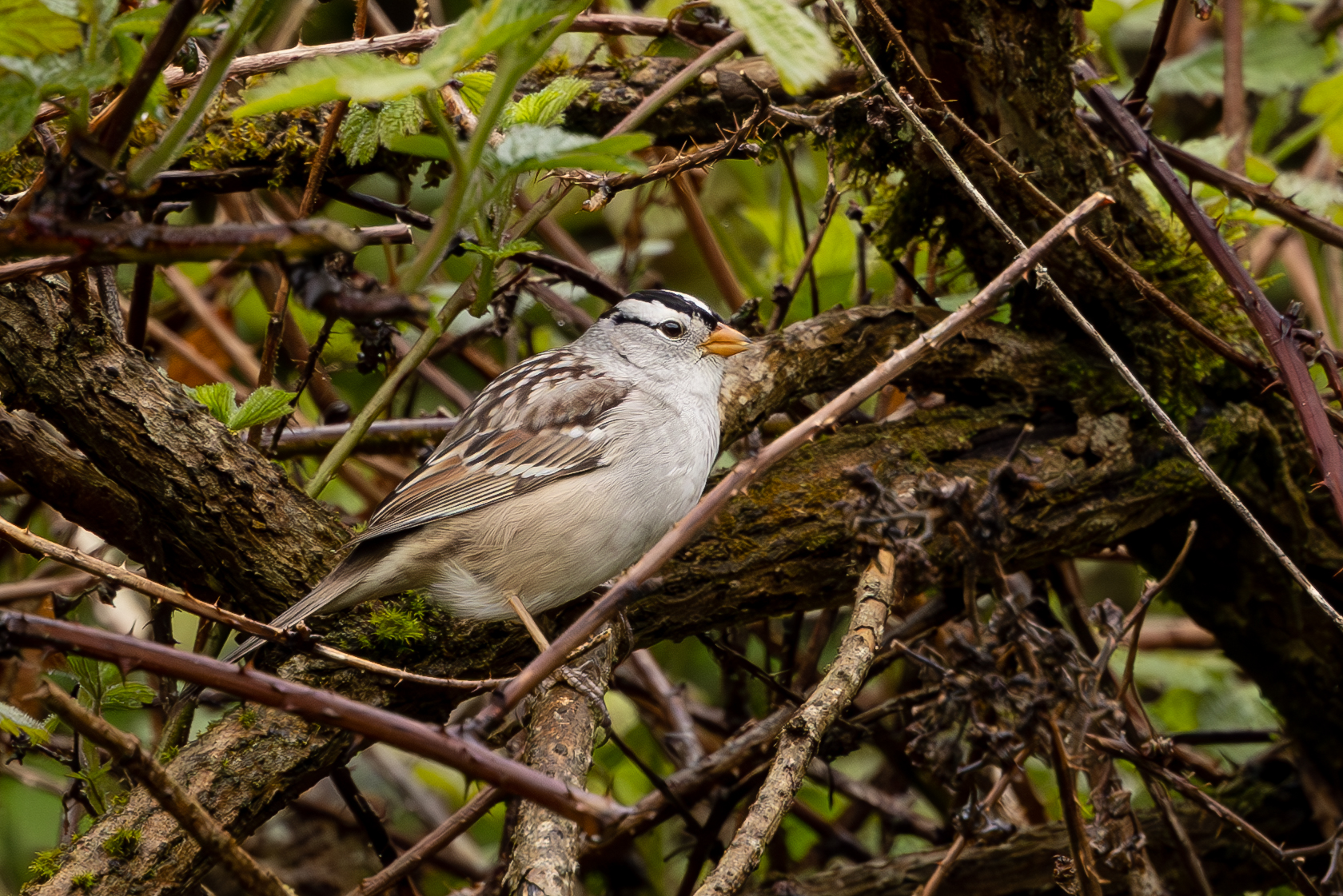
In 2008 I had not really started this twitching lark. My first ring ouzel, red-necked grebe and wood sandpiper were all in Spring that year. So a very rare sparrow in Norfolk in January/ February unfortunately passed me by. In the intervening 15 years there have been a handful of records but not a real twitchable bird. So, when news broke of a white-crowned sparrow in Sussex I was very interested. The news wasn't great though. It was incredibly elusive, hiding in thick scrub. Word came out of people spending 10 hours or more for incredibly poor or no views. I was even in Sussex on Monday and Tuesday but didn't have the time to spend hours staring at a bush. Finally though, on Tuesday, it succumbed to the copious amounts of bird seeds spread over the area it was in and started to show well. My first opportunity to go was on Friday so the alarm was set for 4.30 and by just before 7 I was pulling into a rather wet and bleak car park on the Sussex downs. There were 4 or 5 other cars disgorging birders and we set off on the short walk through the scrubby woodland to the designated viewing area.
There was a short ride through the bushes at the end of which was an area liberally strewn with bird food. I guess 15 people were pointing lenses and 'scopes at it. It quickly became clear that the funnel-effect created by the ride meant viewing would be tricky as only a small area of open ground was on view. It had been made clear the day before that under no circumstance should you go any further as the bird was still very nervous and would disappear for long periods!
Anyway, I only had to wait 5 minutes before a bloke on my left had it in view. From my angle I couldn't see it so I relocated to the left-end of the line and there it was, sitting in a tree! As the song (almost) goes "15 years of hurt" got back. 
It flew off before I could get a photo but it only took 10 minutes for it to return and this time to be in view for me. As you can see, it was still 30 yards or so away and partly obscured. 
Cropping in you get to see it in all its majesty. Although it's "just" a dull grey sparrow from the neck down, its head is stunning. The black-and-white stripes set off by that orange bill made it visible to the naked eye even at that distance. It should be n America, where I have seen many of them, General consensus of opinion is that given the closeness to the coast this probably hitched a ride on a passing ship to get across the Atlantic! We will, of course, never know.
Quite quickly a pattern of behaviour became established. It always flew in from our right, settled on the brambles, flew to this moss covered tree and then flopped down to feed on the seed on the ground.

Unfortunately it seemed to spend most of its time feeding out of sight for anyone in the line. Only occasionally did it walk to the left and become visible to us.
Most of the time the views were more like these ones as the low-growing plants gave it great natural cover.

Still, the fact we had established its pattern meant we now had become experts at spotting it when it returned and describing where it was - the mossy tree, the curvy bramble, the bramble patch all became part of our lexicon. You just had to wait for it to settle in view for wherever you were and hope!


As the morning went on, people came and went and the crowd grew to around 30 or more. With the weather not improving I called it a day about 11 and headed back for coffee.
A really good day. My first lifer of the year and not one I would have predicted. Takes me to 407BOU and hopefully more to come over the next few months. 


Monday, 13 February 2023

A little local twitching

With nice weather forecast and some free time, I decided to do a Hertfordshire day and mop up a few local year ticks. I really should have gone off to Norfolk where more quality birds were on offer but the thought of a 4am alarm didn't seem that attractive. So, I hatched a plan and set off just before 7 for the furthest part of the route. This was to Wallington near Baldock for the corn buntings which have a  stronghold in the fields there.
It was a bit bleak when I arrived, the sun barely breaking though the morning clag. Even the local buzzards didn't seem to want to fly around and were hopping around more like secretary birds searching for worms!
There are three pull-offs where you can normally find the corn buntings and at the middle one there were 3 or 4 males singing away, their "jangling coins" adding a touch of Spring to the morning.
They are a medium-sized bird with a very stout beak and fortunately do like to sit out in the open when declaring their presence. The sun was now just starting to break through but I had a list to get through so I left them to it and drove the short distance to my next step, Fairlands Lake in Stevenage. A caspian gull has made this its winter home for the last few years and is normally pretty reliable. Today though I couldn't find it, at least not convincingly, amongst all the black-headed and only a very few larger gulls.
The local grebes were busy catching their breakfast though.

I gave up on the hope of the caspian gull and drove to Bramfield churchyard, a known local spot for overwintering hawfinches. By now it was a lovely if slightly chilly day and a flock of small birds were feeding in the yew trees. I immediately got onto a really smart male brambling in with the chaffinches. 

It didn't hang around though and flew off toward the village. For half an hour I wandered the churchyard, spotting smaller finches and redwings feeding on the ground. I thought I could hear the hawfinches calling but couldn't see them. Finally I spied two large finches with enormous nut-cracking beaks on top of the trees.
They seemed to be liking the sunshine but remained very distant. Their beaks are spectacular and can crack very large nuts. After a few minutes they followed the brambling and flew off towards the village. 
For my last stop I went to Lemsford Springs, a small HMWT reserve near St. Albans. It is famous for its population of green sandpipers which number over a dozen and are part of a ringing programme. One is the oldest known green sandpiper at over 14 years old! Once I worked out how to get in, I discovered a beautiful little oasis, with lots of birds and very few people. There are two hides overlooking the clear stream which was a magnet for the green sandpipers,


little egrets,


and a lone grey wagtail.
I had hoped to find the jack snipe which had been spotted recently but there was no sign. Still, a good day, with 4 year ticks and some quality birds.